

Shared Services Centres (SSCs) are under increasing pressure. What began as cost-efficient consolidations of back-office functions (finance, HR, procurement, customer, IT support and other operations) is now expected to deliver greater agility, deeper insight, stronger compliance, and even strategic value to the core business. To meet these expectations, many SSCs face a technology inflection: moving beyond robotic process and task automation (RPA) to a new paradigm of autonomous decision-making enabled by agentic AI.
In this post we explore:
- What agentic AI is, and why it matters for shared services.
- The operating-model implications for SSCs.
- How a low-code platform like Mendix supports the journey.
- A suggested roadmap and key success factors.
What Is “Agentic AI” - and Why It Matters for Shared Services
The term “agentic AI” refers to AI systems that go beyond rule-based automation or simple assistants; they reason, plan, act, and learn from experience with some level of autonomy. According to the IBM Institute for Business Value (IBV), more than three-quarters of executives believe that to unlock full benefit from agentic AI, you need a new operating model, not just faster automation of old workflows.
In the SSC context this is significant for several reasons:
Shared service functions are often high-volume, high-standardisation operations (invoicing, onboarding, payroll, vendor management) - making them natural targets for automation and optimisation.
- But SSCs today face increasing complexity: more data sources (structured and unstructured), more exception workflows, more regulatory/compliance requirements, continually changing business conditions. Traditional RPA struggles to keep up. Legacy RPA and even “copilots” are insufficient - what SSCs really need is multi-agent systems that coordinate and adapt.
- By embracing agentic AI, SSCs can shift from doing the same work faster to doing new work, making decisions, predicting issues, autonomously remediating exceptions with human in the loop, thereby delivering strategic value for business rather than just mere cost reductions.
Key statistics worth noting:
- In IBV’s survey, 24% of executives say AI agents already take independent action in their organisation; by 2027 67% expect that to be the case.
- 78% of respondents say achieving maximum benefit from agentic AI requires a changed operating model.
For shared services, this means adopting a mindset of autonomous service-operations, not simply more efficient back-office obtaining and delivering tasks.
Operating Model Implications for Shared Services
Transitioning to agentic AI in an SSC has broad implications across structure, processes, governance and workforce. Some key considerations:
1. From process-centric to goal-centric workflows
Traditional SSCs are often organised by process (e.g., invoice entry → approval → payment). With agentic AI, you aim to define business outcomes (e.g., “vendor payments straight-through,<1% exceptions, resolved within 24h”) and let agentic systems orchestrate across tasks and systems. The IBM IBV report emphasises this shift:transformative organisations view agentic AI as a catalyst to do entirely new capabilities, not just speed up the old.
2. Multi-agent orchestration and service fabric
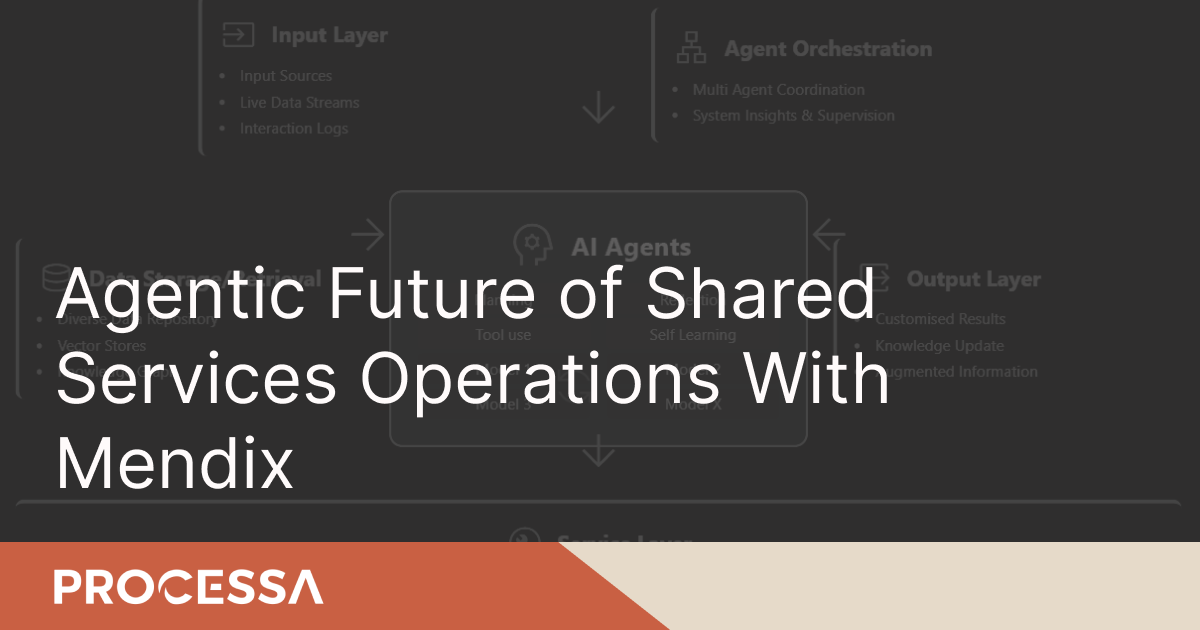
In the shared services world, work spans multiple systems, departments, geographies, data sources and stakeholders. The future of SSCs is “multi-agent” - teams of agents rather than single bots -coordinating across the full value chain. With Mendix you can build: one agent extracting invoice data, another checking compliance and policy, another triggering payment and flagging anomalies, and a supervisory agent monitoring(service level agreements) SLA and escalations. This autonomous service-fabric approach builds resilience, scale and responsiveness, and with human in the loop it enables employees to deliver more value within the same time frame.
3. Data & systems integration as foundation
To unlock agentic capability, you need integrated data flows, cross-system connectivity, real-time context, analytics feeding into decision-making agents. IBM highlights that agentic AI operating models rely on broad data sources (ERP, legacy systems, external inputs) and direct action (not just analysis). For an SSC this means investing in integration and data-orchestration, actual machine learning and artificial intelligence, not just superficial automation of various tasks by various not-coordinated tools.
4. Human-agent teaming for governance and trust
Agentic systems raise new governance needs:how do you ensure agents act within policy, audit trails, transparency, human-in-loop escalation for high-risk decisions? IBM reports that decision-making, human oversight, workforce evolution and trust are central to mature agentic operating models. Mendix provides the governance guardrails and policy-driven controls needed to safely deploy AI agents - ensuring every agent action is auditable, permission-based, and aligned with enterprise risk and compliance frameworks. For SSCs, which often handle regulated tasks (finance, compliance, HR), these factors are non-negotiable.
5. Talent, workforce and role evolution
As agent stake on routine, rules-based work,SSC workforce roles evolve: more focus on analytics, strategy, exception management, relationship management. Shared services leaders must manage change, upskill staff, redefine roles. Workforce evolution is part of the agentic shift, which enables prepares and enables people to bring value to core business.
6. KPIs and new value metrics
When you shift from cost-savings to autonomous decision-making and new capabilities, you need new KPIs.Traditional metrics (e.g., cost per transaction) are still relevant but insufficient, therefore organzations have to adapt to agentic future and think of value based KPIs to measure the progress and results e.g. Agent Autonomy Rate (Percentage of transactions or decisions completed fully by agents without human intervention-“% of procure-to-pay cases fully resolved autonomously”) or Cost of Exception per Agent Action (Helps SSCs quantify where to target optimisation- “Average cost of escalated cases triggered by AI agent.”)
How Mendix Supports the Agentic-AI Journey in Shared Services
A low-code platform like Mendix offers several distinctive advantages for SSCs looking to adopt agentic AI - both as agent developer, but also orchestrator and core platform for value delivery.
1. Rapid development of workflow and agent-interfaces
Mendix is an ai-driven low-code application development platform that facilitates building apps from conception to deployment. For SSCs, this means employees can quickly build front-ends, dashboards, exception-handling apps, agent-orchestration portals without large development backlog. This speed supports incremental rollout of agentic capabilities.
2. Integration & extensibility
Mendix supports connections to REST, SOAP,JDBC, OData, event streams, and integrates with various enterprise systems. Foran SSC environment where data lives across ERP, HRIS, procurement systems, cloud services, this connectivity is crucial. The platform becomes the “glue”for agent workflows, data access, user interaction and legacy modernization.
3. Workflow automation and orchestration
The Mendix platform includes workflow logic, visual modelling of business logic and automation elements. This means you can build the orchestration layer for agents: capture process flows, exception routing, human-agent handover, escalation logic - all within a one unified Mendix platform.
4. Agentic AI enablement & component reuse
Mendix features such starter apps templates e.g. for a conversational support agent, and has extensibility for AI/ML models and reuse of components. Thus, you can embed or orchestrate agents(e.g., invoice-agent, compliance-agent) by leveraging low-code constructs and connecting to agent frameworks or APIs. This enables an SSC to experiment with agentic workflows without completely re-architecting from scratch.
5. Governance, deployment and security
Mendix supports security, deployment via Mendix Cloud, dedicated clusters, shared responsibility model etc. For a shared services organisation with demands for reliability, compliance, global deployments, Mendix enterprise-grade platform is advantageous.
6. Legacy modernization & scalability
Many SSCs struggle with legacy systems. Mendix supports containerization, microservices, modular architecture, API-first design, enabling modular upgrades and scaling. This is particularly relevant when moving to agentic models - they often demand more agility and modularity.
In short: Mendix provides the rapid-application, integration, orchestration and governance foundation on which agentic AI can be built and scaled in a shared services context.
Why Shared Service Centres Should Act Now
- Competitive pressure: the “window for first-mover advantage” in agentic models is narrowing.
- Cost pressures + talent scarcity: SSCs must deliver more with less; agentic AI offers possibility of scale, speed and resilience.
- Shift from efficiency to value-creation: SSCs can move from being cost centres to enabling strategic capabilities (real-time insight, decision support, service innovation).
- Platform maturity: Low-code platforms like Mendix make it easier to build agentic - enabled workflows faster and integrate with existing systems without heavy custom development.
- Risk of being left behind: Organisations that stick with legacy automation and don’t evolve their operating model may fall behind those that embed intelligence and autonomy into their SSC operations.
Conclusion
The evolution of shared services is moving beyond automation and centralisation toward intelligent, autonomous service platforms. For SSCs to remain relevant - and strategic - adopting agentic AI is no longer optional. But technology alone won’t suffice: it requires a new operating model, orchestration of multiple intelligent agents, integrated data and systems, strong governance, and a platform-based delivery model.
A low-code platform like Mendix can serve as a foundational enabler: enabling rapid workflow development, system integration, agent orchestration, governance and scaling. For shared service leaders, the strategic question becomes: How do we design our SSC for agentic capability? – from pilot to scale, from tasks to outcomes, from cost-centre to value-centre.